
ENTP and Introverted Sensing (Si)
Introverted Sensing (Si) Unlocks ENTPs


I’m frequently asked why I don’t focus on ENTPs because I am an ENTP myself.
First off, I am interested in female ENTPs in SF or NY that are potential founders or asset managers. The caveat is that I ideally want to meet them when they are 35 years old at a cadence of once a year that increases as they approach 40. Here’s why.
The four highest earning MBTI types are typically ESTJ, ENTJ, INTJ and ENTP. I’m interested in all of them becoming LPs in INTJ Fund if we are socially compatible.
Let’s look at the cognitive function preferences and development of the four MBTI types that typically make the most money in contemporary society.
ESTJ: develop extroverted thinking (Te) first and introverted sensing second (Si)
ENTJ: develop extroverted thinking (Te) first and introverted intuition second (Ni)
INTJ: develop introverted intuition (Ni) first and extroverted thinking second (Te)
ENTP: develop extroverted intuition (Ne) first and introverted thinking second (Ti)
Three of the top four earning MBTI types develop extroverted thinking (Te) early and use it often. Extroverted thinking (Te) seems to be the most useful cognitive function for making money in isolation.
ENTPs do not use Te and they are often behind in their 20s. But they rapidly climb in their 40s past everyone else. I have a conjecture as to why ENTPs start slow and surge late. The graph below is outdated and represents the average person. But these numbers are even more extreme for outliers of each type and because of inflation.
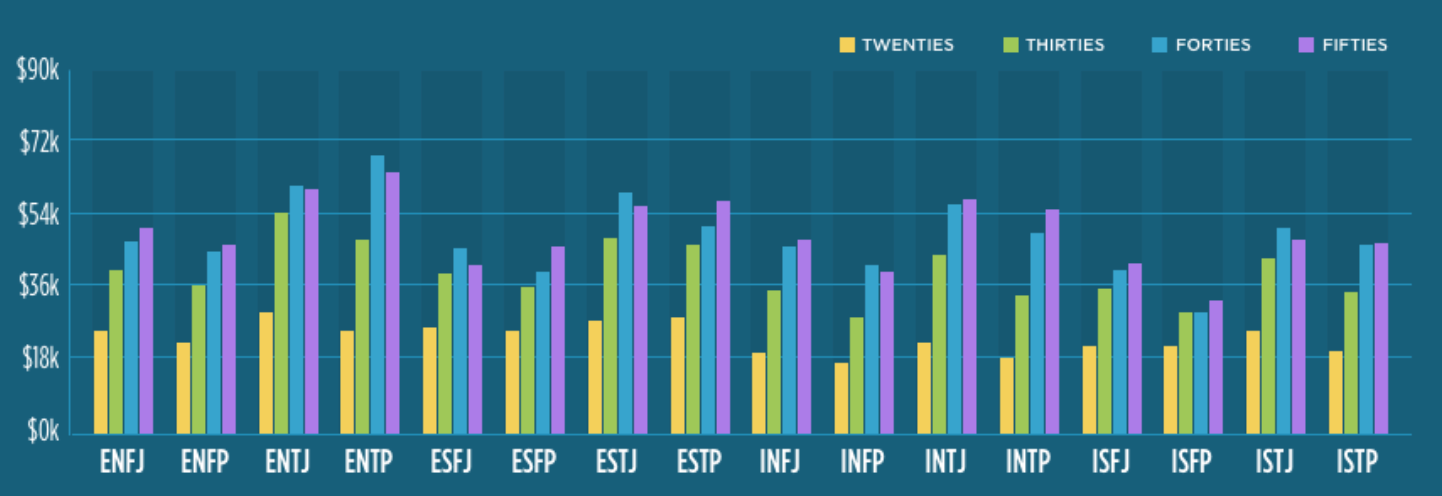
ENTPs unlock their potential with introverted sensing
ENTP cognitive function development occurs in the following order:
Extroverted Intuition (Ne) - Ne is an information gathering cognitive function associated with pattern recognition, theory construction and conceptualizing future possibilities. It’s what ENTPs develop first and use the most. The other cognitive functions are subservient to Ne for an ENTP.
Introverted Thinking (Ti) - Ti is a decision making cognitive function focused on building internal frameworks focused on logic and consistency. It emphasizes depth, accuracy, and core principles over speed. This is the second most used cognitive function for ENTPs. Ti in conjunction with Ne is why ENTPs probe ideas from different angles for structural validity. ENTPs are labeled as devil’s advocates or debaters. But both of these labels are imprecise representations.
Extroverted Feeling (Fe) - Fe allows ENTPs to understand group dynamics and read the room. This is what allows ENTP to be highly persuasive. This is when ENTPs develop cognitive empathy. ENTPs gain understanding of what other people feel but can choose whether or not they care. Other types that concurrently experience affective or compassionate empathy with cognitive empathy may find this dichotomy challenging to grasp.
Introverted Sensing (Si) - Si references past memories to make decisions in the present for ENTPs. ENTPs dislike routine and repetition unless there is a strong motivation or outcome which justifies it.
Pattern recognition (Ne), systems accuracy (Ti), and persuasion (Fe) are only unlocked for ENTPs when past experience reflection (Si) is integrated for an ENTP. At least when it comes to money.
ENTPs have great ideas in their 20s. They can build alliances, partnerships and raise money effectively as founders in their 30s. In their 40s, they start referencing past experiences and focus on what works for them. The last cognitive function developed is the most important thing for ENTPs when it comes to career progression.
ENTPs typically gain self discipline and consistency in midlife that previously did not exist. If you are an exception, I’m happy to meet you earlier.
In a gaming analogy, ESTJs and ENTJs have the best early game scaling which allows them to have a resource advantage headed into mid-game. INTJs fall somewhere in the middle between ESTJs/ENTJs and ENTPs. ENTPs are hyper-scaling types provided they don’t fall too far behind in the early game.
Personal experiences with Introverted Sensing
What has worked best for me in terms of social strategy is focusing on high achieving and mentally stable INTJ women in tech or asset management. Female INTJs provide consistent, compounding and cascading value to me. They are different enough from each other given personal interests in a way that the repetition does not bore me. ENTPs are averse to routine unless it leads to something fun or beneficial that they can’t obtain otherwise. Every ENTP will have their own views as to when their aversion to using introverted sensing is worth the price.
The price for me is unique perspectives gained from users of introverted intuition (Ni). INTJs and INFJs use Ni the most. I planned on essays for all 16 MBTI types. I only wrote essays about my two favorite types in INTJs and INFJs and then stopped without finishing. This includes never bothering to write anything about my own type for five years up until now.
What about ENTP men?
I’m open minded to ENTP men provided we meet and there are zero signs of mimetic rivalry. Expending energy on competitive behaviors which do not directly lead to asset accumulation is stupid.
Why no ENTP focus when you are one?
The nuanced answer is timing and projected relationship retention which affects expected life time value. I want to meet high achieving ENTP women when they are in their 30s maybe once a year and more frequently as they get closer to 40.
This explanation is too verbose to explain within the context of a brief networking exchange of two to three minutes. But if you ask me in person, I’ll send you this essay.
If you are an ENTP and read this. I’d love to learn about how you use and develop your Si.